BREAKING!
Dancing in the streets! (Franklin and Columbia Streets!)
As Tarheels celebrate UNC's win over Duke (74-66)

North Carolina rallies to beat No. 5 Duke 74-66


 Posts
All Comments
Posts
All Comments








Tuesday, February 18, 2014
"One-Percent Jokes and Plutocrats in Drag:
What I Saw When I Crashed a Wall Street Secret Society"
By Kevin Roose
"Recently, our nation’s financial chieftains have been feeling a little unloved. Venture capitalists are comparing the persecution of the rich to the plight of Jews at Kristallnacht, Wall Street titans are saying that they’re sick of being beaten up, and this week, a billionaire investor, Wilbur Ross, proclaimed that “the 1 percent is being picked on for political reasons.” Ross's statement seemed particularly odd, because two years ago, I met Ross at an event that might single-handedly explain why the rest of the country still hates financial tycoons – the annual black-tie induction ceremony of a secret Wall Street fraternity called Kappa Beta Phi.
“Good evening, Exalted High Council, former Grand Swipes, Grand Swipes-in-waiting, fellow Wall Street Kappas, Kappas from the Spring Street and Montgomery Street chapters, and worthless neophytes!” It was January 2012, and Ross, wearing a tuxedo and purple velvet moccasins embroidered with the fraternity’s Greek letters, was standing at the dais of the St. Regis Hotel ballroom, welcoming a crowd of two hundred wealthy and famous Wall Street figures to the Kappa Beta Phi dinner. Ross, the leader (or “Grand Swipe”) of the fraternity, was preparing to invite 21 new members — “neophytes,” as the group called them — to join its exclusive ranks.
Looking up at him from an elegant dinner of rack of lamb and foie gras were many of the most famous investors in the world, including executives from nearly every too-big-to-fail bank, private equity megafirm, and major hedge fund. AIG CEO Bob Benmosche was there, as were Wall Street superlawyer Marty Lipton and Alan “Ace” Greenberg, the former chairman of Bear Stearns. And those were just the returning members. Among the neophytes were hedge fund billionaire and major Obama donor Marc Lasry and Joe Reece, a high-ranking dealmaker at Credit Suisse. [To see the full Kappa Beta Phi member list, click here.] All told, enough wealth and power was concentrated in the St. Regis that night that if you had dropped a bomb on the roof, global finance as we know it might have ceased to exist.
During his introductory remarks, Ross spoke for several minutes about the legend of Kappa Beta Phi – how it had been started in 1929 by “four C+ William and Mary students”; how its crest, depicting a “macho right hand in a proper Savile Row suit and a Turnbull and Asser shirtsleeve,” was superior to that of its namesake Phi Beta Kappa (Ross called Phi Beta Kappa’s ruffled-sleeve logo a “tacit confession of homosexuality”); and how the fraternity’s motto, “Dum vivamus edimus et biberimus,” was Latin for “While we live, we eat and drink.”
On cue, the financiers shouted out in a thundering bellow: “DUM VIVAMUS EDIMUS ET BIBERIMUS.” The only person not saying the chant along with Ross was me — a journalist who had sneaked into the event, and who was hiding out at a table in the back corner in a rented tuxedo.
I’d heard whisperings about the existence of Kappa Beta Phi, whose members included both incredibly successful financiers (New York City's Mayor Michael Bloomberg, former Goldman Sachs chairman John Whitehead, hedge-fund billionaire Paul Tudor Jones) and incredibly unsuccessful ones (Lehman Brothers CEO Dick Fuld, Bear Stearns CEO Jimmy Cayne, former New Jersey governor and MF Global flameout Jon Corzine).
It was a secret fraternity, founded at the beginning of the Great Depression, that functioned as a sort of one-percenter’s Friars Club. Each year, the group’s dinner features comedy skits, musical acts in drag, and off-color jokes, and its group’s privacy mantra is “What happens at the St. Regis stays at the St. Regis.” For eight decades, it worked. No outsider in living memory had witnessed the entire proceedings firsthand.
I wanted to break the streak for several reasons. As part of my research for my book, "Young Money", I’d been investigating the lives of young Wall Street bankers – the 22-year-olds toiling at the bottom of the financial sector’s food chain. I knew what made those people tick. But in my career as a financial journalist, one question that proved stubbornly elusive was what happened to Wall Streeters as they climbed the ladder to adulthood.
Whenever I’d interviewed CEOs and chairmen at big Wall Street firms, they were always too guarded, too on-message and wrapped in media-relations armor to reveal anything interesting about the psychology of the ultra-wealthy. But if I could somehow see these barons in their natural environment, with their defenses down, I might be able to understand the world my young subjects were stepping into. So when I learned when and where Kappa Beta Phi’s annual dinner was being held, I knew I needed to try to go.
Getting in was shockingly easy — a brisk walk past the sign-in desk, and I was inside cocktail hour. Immediately, I saw faces I recognized from the papers. I picked up an event program and saw that there were other boldface names on the Kappa Beta Phi membership roll — among them, then-Citigroup CEO Vikram Pandit, BlackRock CEO Larry Fink, Home Depot billionaire Ken Langone, Morgan Stanley bigwig Greg Fleming, and JPMorgan Chase vice chairman Jimmy Lee. Any way you count, this was one of the most powerful groups of business executives in the world. (Since I was a good 20 years younger than any other attendee, I suspect that anyone taking note of my presence assumed I was a waiter.)
I hadn’t counted on getting in to the Kappa Beta Phi dinner, and now that I had gotten past security, I wasn’t sure quite what to do. I wanted to avoid rousing suspicion, and I knew that talking to people would get me outed in short order. So I did the next best thing — slouched against a far wall of the room, and pretended to tap out emails on my phone.
After cocktail hour, the new inductees – all of whom were required to dress in leotards and gold-sequined skirts, with costume wigs – began their variety-show acts. Among the night’s lowlights:
• Paul Queally, a private-equity executive with Welsh, Carson, Anderson, & Stowe, told off-color jokes to Ted Virtue, another private-equity bigwig with MidOcean Partners. The jokes ranged from unfunny and sexist (Q: “What’s the biggest difference between Hillary Clinton and a catfish?” A: “One has whiskers and stinks, and the other is a fish”) to unfunny and homophobic (Q: “What’s the biggest difference between Barney Frank and a Fenway Frank?” A: “Barney Frank comes in different-size buns”).
• Bill Mulrow, a top executive at the Blackstone Group (who was later appointed chairman of the New York State Housing Finance Agency), and Emil Henry, a hedge fund manager with Tiger Infrastructure Partners and former assistant secretary of the Treasury, performed a bizarre two-man comedy skit. Mulrow was dressed in raggedy, tie-dye clothes to play the part of a liberal radical, and Henry was playing the part of a wealthy baron. They exchanged lines as if staging a debate between the 99 percent and the 1 percent. (“Bill, look at you! You’re pathetic, you liberal! You need a bath!” Henry shouted. “My God, you callow, insensitive Republican! Don’t you know what we need to do? We need to create jobs,” Mulrow shot back.)
• David Moore, Marc Lasry, and Keith Meister — respectively, a holding company CEO, a billionaire hedge-fund manager, and an activist investor — sang a few seconds of a finance-themed parody of “YMCA” before getting the hook.
• Warren Stephens, an investment banking CEO, took the stage in a Confederate flag hat and sang a song about the financial crisis, set to the tune of “Dixie.” (“In Wall Street land we’ll take our stand, said Morgan and Goldman. But first we better get some loans, so quick, get to the Fed, man.”)
A few more acts followed, during which the veteran Kappas continued to gorge themselves on racks of lamb, throw petits fours at the stage, and laugh uproariously. Michael Novogratz, a former Army helicopter pilot with a shaved head and a stocky build whose firm, Fortress Investment Group, had made him a billionaire, was sitting next to me, drinking liberally and annotating each performance with jokes and insults. “Can you f****n’ believe Lasry up there?” Novogratz asked me. I nodded. He added, “He just gave me a ride in his jet a month ago.”
The neophytes – who had changed from their drag outfits into Mormon missionary costumes — broke into their musical finale: a parody version of “I Believe,” the hit ballad from The Book of Mormon, with customized lyrics like “I believe that God has a plan for all of us. I believe my plan involves a seven-figure bonus.” Amused, I pulled out my phone, and began recording the proceedings on video. Wrong move.
“Who the hell are you?” Novogratz demanded. I felt my pulse spike. I was tempted to make a run for it, but – due to the ethics code of the New York Times, my then-employer – I had no choice but to out myself. “I’m a reporter,” I said. Novogratz stood up from the table. "You’re not allowed to be here," he said. I, too, stood, and tried to excuse myself, but he grabbed my arm and wouldn’t let go.
“Give me that or I’ll f****g break it!” Novogratz yelled, grabbing for my phone, which was filled with damning evidence. His eyes were bloodshot, and his neck veins were bulging. The song onstage was now over, and a number of prominent Kappas had rushed over to our table. Before the situation could escalate dangerously, a bond investor and former Grand Swipe named Alexandra Lebenthal stepped in between us. Wilbur Ross quickly followed, and the two of them led me out into the lobby, past a throng of Wall Street tycoons, some of whom seemed to be hyperventilating.
Once we made it to the lobby, Ross and Lebenthal reassured me that what I’d just seen wasn’t really a group of wealthy and powerful financiers making homophobic jokes, making light of the financial crisis, and bragging about their business conquests at Main Street’s expense. No, it was just a group of friends who came together to roast each other in a benign and self-deprecating manner. Nothing to see here. But the extent of their worry wasn’t made clear until Ross offered himself up as a source for future stories in exchange for my cooperation. “I’ll pick up the phone anytime, get you any help you need,” he said. “Yeah, the people in this group could be very helpful,” Lebenthal chimed in. “If you could just keep their privacy in mind.”
I wasn’t going to be bribed off my story, but I understood their panic. Here, after all, was a group that included many of the executives whose firms had collectively wrecked the global economy in 2008 and 2009. And they were laughing off the entire disaster in private, as if it were a long-forgotten lark. (Or worse, sing about it — one of the last skits of the night was a self-congratulatory parody of ABBA’s “Dancing Queen,” called “Bailout King.”) These were activities that amounted to a gigantic middle finger to Main Street and that, if made public, could end careers and damage very public reputations. After several more minutes spent trying to do damage control, Ross and Lebenthal escorted me out of the St. Regis.
As I walked through the streets of midtown in my ill-fitting tuxedo, I thought about the implications of what I’d just seen. The first and most obvious conclusion was that the upper ranks of finance are composed of people who have completely divorced themselves from reality. No self-aware and socially conscious Wall Street executive would have agreed to be part of a group whose tacit mission is to make light of the financial sector’s foibles. Not when those foibles had resulted in real harm to millions of people in the form of foreclosures, wrecked 401(k)s, and a devastating unemployment crisis.
The second thing I realized was that Kappa Beta Phi was, in large part, a fear-based organization. Here were executives who had strong ideas about politics, society, and the work of their colleagues, but who would never have the courage to voice those opinions in a public setting. Their cowardice had reduced them to sniping at their perceived enemies in the form of satirical songs and sketches, among only those people who had been handpicked to share their view of the world. And the idea of a reporter making those views public had caused them to throw a mass temper tantrum.
The last thought I had, and the saddest, was that many of these self-righteous Kappa Beta Phi members had surely been first-year bankers once. And in the 20, 30, or 40 years since, something fundamental about them had changed. Their pursuit of money and power had removed them from the larger world to the sad extent that, now, in the primes of their careers, the only people with whom they could be truly themselves were a handful of other prominent financiers.
Perhaps, I realized, this social isolation is why despite extraordinary evidence to the contrary, one-percenters like Ross keep saying how badly persecuted they are. When you’re a member of the fraternity of money, it can be hard to see past the foie gras to the real world.”
John Mack: Stop Beating Up on Lloyd Blankfein and Jamie Dimon
By Maureen Farrell
The CEOs of Goldman Sachs and J.P. MorganJPM -2.10% don’t deserve the public’s wrath, John Mack, the former CEO of Morgan Stanley told Bloomberg Television Tuesday.
Mr. Mack called the overall debate over pay on Wall Street a healthy one that “needs to take place” every year, but he rose to the defense of his former rivals or peers. “I would love to see you stop beating up on Lloyd and Jamie. I think that would make a lot of sense and I’m in favor of that.”
Still he said, big banks were in a better position to justify high paychecks for top executives before the financial crisis back when “Wall Street was knocking the cover off the ball.”
Mr. Mack also discussed his views on the emerging markets. “You have to have some piece of your portfolio dedicated to emerging markets.”
And Lending Club, the peer-to-peer lending site where he serves on the board. Mr. Mack said he’s happy that banks are starting to take notice and get worried about peer-to-peer lending.
Watch the Bloomberg Television video here:
Today, a majority of Americans - finally - are ready to admit the war against Afghanistan was a mistake. "For the first time since the U.S. initially became involved in Afghanistan in 2001," reported Gallup this morning, "Americans are as likely to say U.S. military involvement there was a mistake as to say it was not."
It took a lot longer for the majority of Americans to realize that than it did for them to realize that U.S. attacks on Korea, Vietnam and Iraq were mistakes - 13 years in Afghanistan, only 5 months in Korea, 2 years in 'Nam, and a year in Iraq. Barbara Lee (D-CA), however, realized it before it even started. In fact, Barbara Lee was the only Member of Congress to realize it - or at least to act on that realization by voting NO. On September 14, 2001, just before midnight, the House voted to give Bush and Cheney the authorization to attack Afghanistan. It passed 420-1.
Barbara Lee is pretty well marginalized by our political elite today and the people who brought us the disastrous war are lionized and rewarded. Even among Democrats, who came to the realization sooner than others that attacking and destroying Afghanistan was a mistake, Lee hasn't been honored or respected. When a corrupt shit-head, Joe Crowley - in fact, the single most corrupt Member of the House Democratic caucus - decided it was time for him to climb the House leadership ladder by running for vice chair of the caucus, a position that puts him on the road to the Speakership, he ran against Barbara Lee. His support - from fellow corruptionists, many of whom he had bribed - was so solid that Barbara withdrew before the vote.
Crowley, of course, had voted for the attack on Afghanistan. He was wrong; Lee was right. But he got the job. Things ended better for me. The Doors and Hendrix and The Dead and all those bands I booked at my school before they were "big," got big. I wound up the president of what they called "a major label" - and was well-rewarded for being right then and right about punk rock in the late '70s when other record company executives were laughing at it and behaving just like Joe Crowley. Is the Democratic Party doomed? Absolutely… just useless. How could anyone even think about voting for a Democrat - not just a bottom of the barrel Democrat like Wendy Greuel, but even the best the Democratic Party has to offer, like Ted Lieu - when there's an independent alternative along the lines of Bernie Sanders. This is from an OpEd yesterday by Marianne Williamson, the independent progressive running for the CA-33 seat Henry Waxman is abandoning.
The fact that a few self-appointed arbiters of who-gets-to-run-and-who-gets-to-play - whether in the area of politics, education, economics or anything else - know they have it in the bag because they hang out with others in the same gang, and they own the system, and they control the media, and they go to the same dinner parties, does not mean that we cannot disenthrall ourselves of their mental filter. And that is all, I assure you, that keeps the lock in place. It is not their money, or even their connections, that makes them masters of our universe. It is the simple fact that we are not laughing at them, but are lining up for their approval instead.
So regardless of whether or not you agree with my political vision, plan to vote for me or support my candidacy, I hope you will join me in recognizing that something is fundamentally wrong when any group of people, including any political party, thinks it's theirs to decide who will be taken seriously, who will have a shot at power, and who will be considered a viable candidate.
That is not their job. That is your job. And if you do agree with my politics and you do wish to see me in office, I hope you will write more of your friends to tell them about my candidacy than you might have; post my website more times on your social media than you might have; and give a couple more bucks to the campaign than you might have. We're trying to penetrate a system here, and it is dense. It is energetic. And it is not amused by free thinkers.
This Historical Amnesia In Gallup's Afghanistan Poll
Is Ukraine Drifting Toward Civil War And Great Power Confrontation?
We Better Get Net Neutrality Signed into Law Before Media Mergers Kill the Internet as We Know It
Monopoly’s Poster Children - Ireland, Europe, The U.S. And The Financial Crooks
The Wal-Mart-ization of Higher Education
In the past thirty-eight years, the percentage of professors holding tenure-track positions has been cut nearly in half. Full-time tenure-stream professors went from 45.1 percent of America’s professoriate in 1975 to only 24.1 percent in 2011, with only one in six (16.7 percent) professors now possessing tenure.
. . . Wal-Mart seems to provide an apt analogy for the economic trend that has occurred in academia. Wal-Mart has become well known for keeping its number of full-time workers to a minimum, and hiring many part-time workers, with low pay, no benefits, and no job security.
“There has been a widescale transformation of the faculty work force,” says Gwen Bradley, communications director for the American Association of University Professors (AAUP). “It’s reflecting what’s happening in the economy in general. Some call it the Wal-Martization of higher education. It’s much cheaper in the short term to hire part-time faculty.”
The Enormity of the Lie
What began decades ago is now becoming more transparent under the Obama regime. Perhaps that’s the transparency Obama promised, for we’ve seen little else in terms of transparency with regard to the man known as Barack Hussein Obama.We must understand the legal restraints that were severed during the Clinton years and the Congress that changed the rules regarding financial institutions.
We must understand that the criminal acts were bold and bipartisan, and were designed to consolidate wealth through the destruction of the middle class.
All of this is part of a much larger plan to establish a one world economy by “killing” the U.S. dollar and consequently, eradicating the middle class by a cabal of globalists that existed and continue to exist within all sectors of our government.
The results will be crippling to not just the United States, but the entire Western world.
For those not locked into the captured corporate media, we’re starting to see the truth emerging. The truth is that we’ve been living under a giant Ponzi scheme and we, the American citizens, are the suckers.
As illustrated by the list of dead bankers above, however, the power elite need a bit more time before the extent of their criminality is revealed.
They need a bit more time to transfer the remaining wealth from middle-class America to their private coffers. Timing is everything, and a magic act only works when all props are in place before the illusion is performed. Only when their timing is right will the slumbering Americans realize the extent of the illusion by which they’ve been entranced, at which time they will be forced into submission to accept a financial reset that will ultimately subjugate them to a global economy.
I contend that this is the reason for the recent spate of deaths, for those who met their tragic and untimely end had the ability to expose this nefarious agenda by what they knew or discovered, or what they would reveal under subpoena and the damage they could cause to the globalist financial agenda.It is an insult to the public intellect that the media so readily pushes the official line that the deaths were all suicides given the unusual circumstances surrounding nearly all of those listed. This in itself should be ringing alarm bells with anyone of reasonable sensibilities, or at last those who are paying the slightest bit of attention to the larger picture.
The media is either complicit or completely inept.
Things are getting worse in the American classroom, not better. The experts and the special interests purporting to fix the educational system are continuing, instead, to asphyxiate it.
The grandiose quote, above, in which “our young people” show up as abstractions needing to be prepped for some simplistic, highly competitive imaginary future (fully understood by the experts), is part of the mission statement of the Common Core State Standards Initiative, the Obama administration’s showcase education reform initiative.
Just like the disastrous No Child Left Behind Act of the Bush era, in whose wake it follows, it’s all about testing and uniform standards and the “rigorous” evaluation of schools and teachers; and it’s clueless about the nature of childhood development, not to mention reality. Its primary mission, as with NCLB, is to pull education out of the hands and hearts of teachers and turn its administration over to politicians and their corporate sponsors. It both defunds and belittles the learning process.
And the primary metaphor for school remains “the pipeline” — either the cradle-to-prison pipeline, which is what education amounts to for so many young people in poverty-stricken neighborhoods, or the cradle-to-career pipeline, as Education Secretary Arne Duncan would have it.
It’s not that the pipeline is broken. Rather, as educator Adam Bessie put it in a brilliant piece of graphic commentary published at Truthout, “the metaphor is broken” — the metaphor of the public schools as an industrial sluiceway, washing our children anywhere at all.
An educational system that fails to revere children and honor their potential — that turns schools into 3R boot camps, demanding the regurgitation of specified data on command, but shrugs off the importance of holistic thinking or simply learning to think for oneself — is insane at its core. Welcome to the 21st century!
Last week’s big business news was the announcement that Comcast, a gigantic provider of cable TV and high-speed Internet service, has reached a deal to acquire Time Warner, which is merely huge. If regulators approve the deal, Comcast will be an overwhelmingly dominant player in the business, with around 30 million subscribers.
So let me ask two questions about the proposed deal. First, why would we even think about letting it go through? Second, when and why did we stop worrying about monopoly power?
On the first question, broadband Internet and cable TV are already highly concentrated industries, with a handful of corporations accounting for most of the customers. Once upon a time antitrust authorities, looking at this situation, would probably have been trying to cut Comcast down to size. Letting it expand would have been unthinkable.
The Terrible Toll of Secrecy
By Dan Froomkin, First Look
15 February 14
he Intercept's inaugural exposé, by my colleagues Glenn Greenwald and Jeremy Scahill, illuminates the deeply flawed interaction between omnipresent electronic surveillance and targeted drone killings - two of the three new, highly disruptive instruments of national power that President Obama has pursued with unanticipated enthusiasm.
All three (the third being cyberwar) have a lot in common. Despite their staggering implications, Obama has proceeded to establish the rules for them unilaterally, almost entirely in secret, based on dubious legal arguments, largely unchecked by judicial or congressional oversight, and with a seemingly unshakeable yet remarkably unfounded faith in their value.
But one of the many major takeaways from the eight-month-and-counting exploration of the trove of secret NSA documents Edward Snowden gave journalists is that what may seem like good ideas within the confines of a like-minded military-intelligence establishment look very different when exposed to overdue public scrutiny.
Only then do you find out they don't work so well. Or that they aren't really legal, or constitutional. Or that they do more harm than good. Or that the government relies on them too much, at the expense of things that might actually work.
History has shown time and again that secrecy and bad decisions go hand in hand.
So the fact that two new, secret U.S. government war-making abilities when used in tandem have particularly disastrous consequences for innocent civilians is newsworthy - but unfortunately not that surprising.
Because of the Obama administration's refusal to disclose its selection or targeting criteria in any detail, it's impossible to determine with any confidence which or how many of the civilian massacres by drone were the product of an over-reliance on SIGINT rather than, say, a HUMINT asset settling a personal score or a government official eliminating possible rivals, or just plain user error.
But it's probably more than the Obama administration would like you to think. The White House's record of truth-telling when it comes to drone warfare is appalling. Years of administration arguments that civilian casualties in drone attacks have been inconsequential have proven again and again to be specious.
Before Director of National Intelligence James Clapper's March 2013 assurance to Congress that the government wasn't collecting data on Americans in bulk, the administration's single biggest whopper might have been White House counter-terrorism adviser John Brennan's assertion in June 2011 that over the previous year there had not been a single collateral death from drone strikes.
Exhaustive independent studies by the British Bureau of Investigative Journalism, the New America Foundation and the Long War Journal have documented that civilian casualties are endemic - the latest count is at least 440 since the drone campaigns began, according to the BIJ.
Obama himself is hardly unaware of the dreadful downside of errant drone strikes. As Daniel Klaidman reported in his book, "Kill or Capture," Obama authorized his very first drone strike on the third full day of his presidency, after having been assured by then-CIA director Michael Hayden that the targets were high-level al Qaeda and Taliban commanders. The Hellfire missile he sent into a compound in Pakistan instead killed a prominent pro-government tribal elder and four members of his family, including two children.
Klaidman wrote that Obama was "understandably disturbed" when he found out what happened, and insisted on some procedural changes. But civilian casualties continued. And each time, Obama evidently convinced himself that it wouldn't happen again.
His most recent public assurance came in an October 2013 speech to the United Nations, where he announced that he had "limited the use of drones so they target only those who pose a continuing, imminent threat to the United States where capture is not feasible, and there is a near certainty of no civilian casualties."
Less than two months later, missiles fired by a U.S. drone killed 13 people in a convoy of vehicles headed to a wedding party in Yemen.
How Obama's faith in his military and intelligence leaders was restored or remained unflagging after all these incidents, despite the skepticism that he so clearly displayed during his first presidential campaign, is surely one of the great mysteries facing his supporters today, and historians tomorrow.
The spirited and informed public debate we need to have over these new ways of war has been stifled by the Obama administration, which has not only made a mockery of its promises of transparency, but has set new records in terms of its hostility toward journalistic leaks.
Congress, meanwhile, has shirked its oversight duties, in an unholy alliance of complicit leaders, happy campaign contributors, Republican ultra-hawks and partisan Democrats who don't want to attack their president, even when he has enshrined precisely the kind of radical militaristic and anti-civil libertarian policies they convinced themselves during the Bush years were temporary aberrations.
And the elite Washington press corps, not yet recovered from its abdication of adversarial journalism after 9/11, has done an astonishingly poor job of raising and pressing important questions.
Where does that leave us?
Here. In a place and time where the only way to have the debate the country so desperately needs is for whistleblowers to speak up, and for independent journalists to make sure that they are heard.
10 Weapons Wall Street Uses to Manipulate You
No quantum computer needed for this profit-making machine
By Paul B. Farrell
February 16 2014
Market Watch
I’ve been observing the Wall Street machine in action since my days at Morgan Stanley years ago. The truth is, Wall Street really doesn’t need a sophisticated high-tech “Infinity Machine.” They’re already in a Snowden-style low-tech “Singularity,” “accelerating returns” skimming money from 95 million Main Street investors.
Remember, Wall Street has only one goal, make insiders superrich, and shareholders rich. The public interest and the rest of the world are never part of their competitive algorithms. Never.
They achieve their goal with the basic ideas of behavioral-finance geniuses like Richard Thaler, by keeping investors in the dark, dependent, irrational and uninformed. Very simple. Here are 10 of Wall Street’s high-tech/low-tech weapons used by their psychological/neuroscientific/behavioral finance cyberwarriors to control their casinos:
1. Hire psychologists, neuroscientists to manipulate the media
Use consulting contracts, grants and retainers and lock up the best talent to work to keep America’s 95 million individual investors “irrational and uninformed” as Thaler says.
2. Free experts constantly deliver Wall Street’s message to media
Network, cable, bloggers must fill their channels every day. Talking heads are free advertising for Wall Street to manipulate investors using so-called news content.
3. Invest megabucks on lobbyists to control politicians, government
Lobbying is one of Wall Street’s best investments. Lobbyists control Washington: control politicians, fight reforms, push favorable laws, regs, spin the truth to mislead investors.
4. Fuel anxiety by pushing the investor’s buy/sell/ trade button
Wall Street’s a casino, makes money on “the action,” skimming a percentage off the top. They fuel investor anxieties, fears, optimism, volatility, maximize action on exchanges.
5. Kill our savings button, undercut self-confidence, long-term planning
Wall Street uses neuroscience technology to sow doubts about retirement security, do-it-yourself investing, how indexing beats trading, then overloads us with misleading ads.
6. High-frequency trading, misleading Wall Street and Main Street
Short-term online trading makes Wall Street billions annually. Hyperactive traders have a competitive edge using high-tech neuroscientific strategies, plus keep markets churning.
7. Brokers trained on aggressive selling and closing techniques
Securities are sold not bought: Broker’s advice is self-serving, often misleading, anything to get a commission. They’re trained to use high-powered psychological techniques.
8. ‘Investor education’ programs are self-serving sales gimmicks
Most Wall Street-sponsored “investor education” programs are loaded with new business, sales and promotional gimmicks. But they help Wall Street present a “we care” persona.
9. New ‘designer’ funds based on latest fads to replace losers
Fund companies constantly design new funds based on the latest fads, for anxious investors chasing higher returns, driven like teenagers who need the latest video games.
10. Retirement gatekeepers: kept in the dark and manipulated
Two-thirds of all funds are controlled by corporate pension and retirement managers. So Wall Street focuses sales pitches on easy-to-manipulate naïve plan managers.
Yes, Wall Street is already in its “Singularity.” The rest of us must wait till 2045.
Meanwhile, Americans need to start asking the hard questions now: Will these new “Infinity Machines” have a soul with a conscience? Know right from wrong? Stop drones from killing good people? Force corporations to put the public interest ahead of shareholder profits? We need to ask the tough questions today ... later may be too late.
(Paul B. Farrell is a MarketWatch columnist based in San Luis Obispo, Calif. Follow him on Twitter @MKTWFarrell.)
A Titanic Defeat
[ 131 ]
February 15, 2014 | Erik Loomis
The United Auto Workers lost its attempt to unionize the Volkswagen plant in Chattanooga after Tennessee politicians interfered to defeat the vote when VW acquiesced to unionization.
In a defeat for organized labor in the South, employees at the Volkswagen plant here voted 712 to 626 against joining the United Automobile Workers.The loss is an especially stinging blow for U.A.W. because Volkswagen did not even oppose the unionization drive. The union’s defeat — in what was one of the most closely watched unionization votes in decades — is expected to slow, perhaps stymie, the union’s long-term plans to organize other auto plants in the South.A retired local judge, Samuel H. Payne, announced the vote results inside VW’s sprawling plant after officials from the National Labor Relations Board had counted the ballots. In the hours before the votes were tallied, after three days of voting at the assembly plant, both sides were predicting victory.It’s hard to overstate what a terrible defeat this is. Here you had the company suggesting the UAW enter their plant so they could create the American version of the German works council that would be illegal without a union election (would violate the company union provisions of the National Labor Relations Act).
The vote this week came in a region that is traditionally anti-union, and as a result many said the U.A.W. faced an uphill battle. The union saw the campaign as a vital first step toward expanding in the South, while Republicans and many companies in Tennessee feared that a U.A.W. triumph would hurt the state’s welcoming image for business.
The UAW will never receive a more favorable opportunity in the American South and just like its failures in the 90's, it came up short. From what I have read so far, it does not seem the UAW messed up the campaign. They did agree with VW to not do home visits, since those went against German union norms.
If the UAW had conducted home visits, no doubt they would have more effectively fought back Bob Corker and Grover Norquist and the outside group propaganda. But if they had pushed home visits from the beginning, they wouldn’t have had a campaign because VW wouldn’t have gone along.
So why did it fail? We can’t blame it all on the politicians and scaremongering. Yes, that probably clinched the failure, but it did not turn 712 votes. There were almost certainly several hundred no votes from the beginning.
Why? First, the white South has always been very difficult to organize. A combination of ideas of self-reliance, the fact that unions are seen as something northern with Yankee ideas, the impact of evangelical religion, and a culture that united rich whites and poor whites through racial solidarity that also created other ties within communities that cut across class have all made unionization strikingly difficult.
For an additional example of the last point, see how the people of West, Texas rallied around the fertilizer plant owner last year after his facility caused an explosion that wiped out half the town. They went to church with him after all.
So there are long, historical struggles to unionize white workers here that go back to the textile towns of southern Appalachia in the 20s and the failure of Operation Dixie in 1946. And while I have not seen any demographics on the racial breakdown of workers in Chattanooga, pretty much all I’ve seen in interviews are white; at the very least, it seems to lean pretty heavily white. So outside groups tainting the UAW with Obama no doubt helped, but it doesn’t explain 712 votes.
There’s also the specter of capital mobility looming over the plant. Even though VW said it wasn’t moving the plant, this was a major theme of the outside groups and it does seem to have affected some workers. Despite left-leaning labor activists beating up Big Labor for a lack of union democracy, far and away the top reason for labor’s decline is the jobs disappearing to nonunion states and to foreign nations.
Given what capital mobility did to Detroit and the subsequent almost mythological role Detroit has played in American culture, it becomes easy to taint the UAW with the decline of Detroit, which was a central part of the anti-union strategy.
On top of that, the UAW having to agree to two-tiered contracts so the Big Three auto makers would keep jobs in Michigan and Ohio, contracts that drastically lowered wages for new workers, did not lend itself to potential new members thinking the UAW was going to make their lives better. That’s a tough spot for the UAW to be in and the blame goes to capital mobility because if the UAW doesn’t agree, those jobs are gone and Lansing and Toledo and other union towns are just dead. So long as corporations can move at a whim, it will be tremendously difficult for labor to win meaningful victories.
But I think another major reason for this loss was that it was never clear to many workers why they were joining a union. Some claim to have been UAW members in the past and had a bad experience, which is the kind of low-level complaining fairly common in all unionized workplaces, often by people who lost a grievance or who screwed up and the union didn’t take on their hopeless case, or they weren’t friends with the shop steward, or whatever.
Who knows. But in any case, the usual union victory results from dissatisfied workers organizing with demands. That really wasn’t the case here. To quote a union organizer friend of mine, “If the vote becomes “Can we trust the Union?” instead of “Should we unite to solve our problems?”, the boss wins.” I think this is fundamentally what this vote was about.
The UAW is considering filing to have the election thrown out because of Bob Corker’s intimidation and there is a real chance he crossed the line. But this is probably a dead campaign. And it’s hard to see how the UAW or any union comes into southern factories and wins major victories at this point. Incredibly dispiriting.
BREAKING: PBS To Return John Arnold’s $3.5 Million, Following Pando Exposé
Interactive Map: The War on Voting Rights
(Click here for interactive map.)
In the magazine this week, Jeffrey Toobin writes about Attorney General Eric Holder and his efforts to enforce the principles of the 1965 Voting Rights Act.
In the Shelby County v. Holder decision of June, 2013, the Supreme Court declared Section 4 of the Act unconstitutional by a vote of five to four, arguing, in essence, that the provision was no longer necessary nearly fifty years after the civil-rights era. Chief Justice John G. Roberts, Jr., wrote the majority opinion, and Justice Ruth Bader Ginsburg penned the dissent, joined by the three other Democratic appointees to the Court.
Section 4 outlined a formula for identifying jurisdictions with a history of racial discrimination. These places included many states in the South and various counties and townships scattered across the country. Under Section 5 of the Act, these places were required to receive “pre-clearance” from the federal government before making any changes to voting laws. Though the Supreme Court didn’t render an opinion on Section 5, striking down Section 4 rendered it punchless — without a coverage formula, there are no places that require pre-clearance.
Events since the Shelby decision show that we might still need Section 5. As the map above illustrates, in the months after the Supreme Court decision most of the states that were subject to preclearance have moved to restrict voting rights. Here’s an outline of what’s happened in those states, highlighted in orange on the map. Most of the new restrictive laws are similar — photo-I.D. laws, shortened early-voting periods, and the like. Such measures make voting more difficult, and, as voting-rights advocates argue, they disproportionately affect poor and minority voters.
In 2011, Alabama, home to the plaintiff Shelby County, approved a photo-I.D. law, but never submitted it for preclearance. After the Supreme Court decision, the state announced that it would go ahead with the law, which officially takes effect during this year’s federal primaries.
Section 5 only covered a handful of Florida counties, but the entire state was subject to pre-clearance. In 2012, Governor Rick Scott, a Republican, launched a program to purge the voter roll of non-citizens. The effort, which disproportionately targeted minorities, was ultimately abandoned under a storm of criticism. However, just a day after Shelby, Scott, who faces re-election in 2014, made plans to renew the purge.
On the day of the Shelby decision, Mississippi’s Secretary of State announced plans to implement a photo-I.D. law in time for this year’s federal primaries.
North Carolina functioned much like Florida — Section 5 coverage for certain counties, but pre-clearance necessary for the entire state. Less than two months after Shelby, the state’s Republican-controlled government passed a sweeping bill that includes several new restrictive voting provisions. Among them are a photo-I.D. requirement, a shorter early-voting period, the end to same-day voter registration and pre-registration for sixteen- and seventeen-year-olds, and the end of straight party-ticket voting. The Justice Department has filed a lawsuit challenging the new voting provisions under Section 2 of the Voting Rights Act.
South Carolina tried to enforce a photo-I.D. law in time for the 2012 elections, but a federal court blocked it in October, arguing that there was insufficient time to educate voters and officials. However, the court said that it could take effect in 2013. Immediately after Shelby, the state Attorney General issued a statement praising the Justices, and the photo-I.D. law was officially implemented in time for a September special election.
JPMorgan Vice President’s Death in London Shines a Light on the Bank’s Close Ties to the CIA
By Pam Martens and Russ Martens
February 12, 2014
The nonstop crime news swirling around JPMorgan Chase for a solid 18 months has started to feel a little spooky – they do lots of crime but never any time; and with each closed case, a trail of unanswered questions remains in the public’s mind.
Just last month, JPMorgan Chase acknowledged that it facilitated the largest Ponzi scheme in history, looking the other way as Bernie Madoff brazenly turned his business bank account at JPMorgan Chase into an unprecedented money laundering operation that would have set off bells, whistles and sirens at any other bank.
The U.S. Justice Department allowed JPMorgan to pay $1.7 billion and sign a deferred prosecution agreement, meaning no one goes to jail at JPMorgan — again.
The largest question that no one can or will answer is how the compliance, legal and anti-money laundering personnel at JPMorgan ignored for years hundreds of transfers and billions of dollars in round trip maneuvers between Madoff and the account of Norman Levy.
Even one such maneuver should set off an investigation. (Levy is now deceased and the Trustee for Madoff’s victims has settled with his estate.)
Then there was the report done by the U.S. Senate’s Permanent Subcommittee on Investigations of the London Whale episode which left the public in the dark about just what JPMorgan was doing with stock trading in its Chief Investment Office in London, redacting all information in the 300-page report that related to that topic.
Wall Street On Parade has been filing Freedom of Information Act (FOIA) requests with the Federal government in these matters, and despite the pledge from our President to set a new era of transparency, thus far we have had few answers coming our way.
One reason that JPMorgan may have such a spooky feel is that it has aligned itself in no small way with real-life spooks, the CIA kind.
Just when the public was numbing itself to the endless stream of financial malfeasance which cost JPMorgan over $30 billion in fines and settlements in just the past 13 months, we learned on January 28 of this year that a happy, healthy 39-year old technology Vice President, Gabriel Magee, was found dead on a 9th level rooftop of the bank’s 33-story European headquarters building in the Canary Wharf section of London.
The way the news of this tragic and sudden death was stage-managed by highly skilled but invisible hands, turning a demonstrably suspicious incident into a cut-and-dried suicide leap from the rooftop (devoid of eyewitnesses or motivation) had all the hallmarks of a sophisticated covert operation or coverup.
The London Evening Standard newspaper reported the same day that “A man plunged to his death from a Canary Wharf tower in front of thousands of horrified commuters today.”
Who gave that completely fabricated story to the press? Commuters on the street had no view of the body because it was 9 floors up on a rooftop – a rooftop that is accessible from a stairwell inside the building, not just via a fall from the roof.
Adding to the suspicions, Magee had emailed his girlfriend the evening before telling her he was finishing up and would be home shortly.
If JPMorgan’s CEO, Jamie Dimon, needed a little crisis management help from operatives, he has no shortage of people to call upon. Thomas Higgins was, until a few months ago, a Managing Director and Global Head of Operational Control for JPMorgan. (A Business Week profile shows Higgins still employed at JPMorgan while the New York Post reported that he left late last year.)
What is not in question is that Higgins was previously the Senior Officer and Station Chief in the CIA’s National Clandestine Service, a component of which is the National Resources Division. (Higgins’ bio is printed in past brochures of the CIA Officers Memorial Foundation, where Higgins is listed with his JPMorgan job title, former CIA job title, and as a member of the Foundation’s Board of Directors for 2013.)
According to Jeff Stein, writing in Newsweek on November 14, the National Resources Division (NR) is the “biggest little CIA shop you’ve never heard of.” One good reason you’ve never heard of it until now is that the New York Times was asked not to name it in 2001.
James Risen writes in a New York Times piece: [the CIA’s] “New York station was behind the false front of another federal organization, which intelligence officials requested that The Times not identify. The station was, among other things, a base of operations to spy on and recruit foreign diplomats stationed at the United Nations, while debriefing selected American business executives and others willing to talk to the C.I.A. after returning from overseas.”
Stein gets much of that out in the open in his piece for Newsweek, citing sources who say that “its intimate relations with top U.S. corporate executives willing to have their companies fronting for the CIA invites trouble at home and abroad.” Stein goes on to say that NR operatives “cultivate their own sources on Wall Street, especially looking for help keeping track of foreign money sloshing around in the global financial system, while recruiting companies to provide cover for CIA operations abroad. And once they’ve seen how the other 1 percent lives, CIA operatives, some say, are tempted to go over to the other side.”
We now know that it was not only the Securities and Exchange Commission, the U.S. Treasury Department’s FinCEN, and bank examiners from the Comptroller of the Currency who missed the Madoff fraud, it was top snoops at the CIA in the very city where Madoff was headquartered.
Stein gives us even less reason to feel confident about this situation, writing that the NR “knows some titans of finance are not above being romanced. Most love hanging out with the agency’s top spies — James Bond and all that — and being solicited for their views on everything from the street’s latest tricks to their meetings with, say, China’s finance minister.
JPMorgan Chase’s Jamie Dimon and Goldman Sach’s Lloyd Blankfein, one former CIA executive recalls, loved to get visitors from Langley. And the CIA loves them back, not just for their patriotic cooperation with the spy agency, sources say, but for the influence they have on Capitol Hill, where the intelligence budgets are hashed out.”
Higgins is not the only former CIA operative to work at JPMorgan. According to a LinkedIn profile, Bud Cato, a Regional Security Manager for JPMorgan Chase, worked for the CIA in foreign clandestine operations from 1982 to 1995; then went to work for The Coca-Cola Company until 2001; then back to the CIA as an Operations Officer in Afghanistan, Iraq and other Middle East countries until he joined JPMorgan in 2011.
In addition to Higgins and Cato, JPMorgan has a large roster of former Secret Service, former FBI and former law enforcement personnel employed in security jobs. And, as we have reported repeatedly, it still shares a space with the NYPD in a massive surveillance operation in lower Manhattan which has been dubbed the Lower Manhattan Security Coordination Center.
JPMorgan and Jamie Dimon have received a great deal of press attention for the whopping $4.6 million that JPMorgan donated to the New York City Police Foundation. Leonard Levitt, of NYPD Confidential, wrote in 2011 that New York City Police Commissioner Ray Kelly “has amended his financial disclosure forms after this column revealed last October that the Police Foundation had paid his dues and meals at the Harvard Club for the past eight years. Kelly now acknowledges he spent $30,000 at the Harvard Club between 2006 and 2009, according to the Daily News.”
JPMorgan is also listed as one of the largest donors to a nonprofit Foundation that provides college tuition assistance to the children of fallen CIA operatives, the CIA Officers Memorial Foundation. The Foundation also notes in a November 2013 publication, the Compass, that it has enjoyed the fundraising support of Maurice (Hank) Greenberg. According to the publication, Greenberg “sponsored a fundraiser on our behalf. His guest list included the who’s who of the financial services industry in New York, and they gave generously.”
Hank Greenberg is the former Chairman and CEO of AIG which collapsed into the arms of the U.S. taxpayer, requiring a $182 billion bailout. In 2006, AIG paid $1.64 billion to settle federal and state probes into fraudulent activities. In 2010, the company settled a shareholders’ lawsuit for $725 million that accused it of accounting fraud and stock price manipulation. In 2009, Greenberg settled SEC fraud charges against him related to AIG for $15 million.
Before the death of Gabriel Magee, the public had lost trust in the Justice Department and Wall Street regulators to bring these financial firms to justice for an unending spree of fleecing the public. Now there is a young man’s unexplained death at JPMorgan. This is no longer about money. This is about a heartbroken family that will never be the same again; who can never find peace or closure until credible and documented facts are put before them by independent, credible law enforcement.
The London Coroner’s office will hold a formal inquest into the death of Gabriel Magee on May 15. Wall Street On Parade has asked that the inquest be available on a live webcast as well as an archived webcast so that the American public can observe for itself if this matter has been given the kind of serious investigation it deserves. We ask other media outlets who were initially misled about the facts in this case to do the same.

The declining number of Americans who hold a job or are looking for one has been a hot topic since the end of the recession. What’s more to blame: the weak recovery or unavoidable long-term trends such as the retirement of baby boomers?
Economists agree both factors are at work. It’s harder to find a job nowadays than in the past, but baby boomers are expected to leave the workforce in greater numbers as more hit retirement age. What’s a matter of dispute is how much blame should be placed on one over the other.
A new study by Goldman Sachs doesn’t resolve the issue, but it offers some interesting insights. Among them: The firm found that bull and bear markets show a strong link in when older workers choose to retire. So the 30% surge in the S&P 500 index in 2013 could spur a bigger wave of baby-boomer retirements in the next year.
Does that mean the labor-force participation rate, now hovering near a 35-year low of 63%, will fall again in the coming months? Not necessarily. The Goldman study also suggests younger people are likely to enter the workforce in greater numbers as the labor market continues to mend.
The behavior of the oldest and youngest workers, it turns out, move in opposite directions during and after a recession.
Even as the economy was crashing in 2008 and 2009, for example, the number of Americans 55 and older joining the labor force actually rose sharply. How come? They needed the money, especially with retirement age approaching and their stock portfolios in the toilet.
Younger people, on the other hand, saw dim job prospects and decided to go to college or get a second degree. Consider this: From 1990 to 2006, the number of youths pursuing education beyond high school rose an average of 260,000 every year. Yet the number spiked to 850,000 in 2008 and a whopping 1.3 million in 2009, Goldman economists Jari Stehn and Hui Shan found.
What about the next few years? The Goldman economists believe the roles could reverse. The firm’s research shows a sizable rise in retirements among workers 55 to 64 when the stock market gains 10%. Last year’s 30% advance could spur an even large wave of workforce departures.
Indeed, the shift already appears to be taking place. The percentage of Americans 55 and older in the workplace actually posted the biggest drop in 2013 since 1980. The rate fell to 39.9% from 40.7% last year – and it fell again in January.
The percentage of 16 to 24 year-olds not in the workplace, on the other hand, appears to have stabilized after tumbling from around 60% in early 2007 to just under 55% in 2013.
Many who entered college after the recession have graduated and need to find a job, a process helped in part by a steady pickup in hiring over the past few years. The U.S. has added more than 2 million new jobs for three straight years.
Does that mean good times are just around the corner? Probably not.
The Goldman Sachs study says the surprisingly rapid decline in the U.S. unemployment rate over the past few years still “understates the extent of the slack”, or weakness, in the labor market. The jobless rate dropped to 6.6% in January from 7.9% one year earlier, largely because more workers dropped out of the labor force.
- Jeffry Bartash
Follow Jeffry on Twitter @jbartash
Follow Capitol Report on Twitter @capitolreport
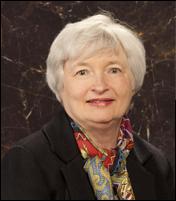
Ms. Yellen, It’s Time to Pay Attention to the Slowdown
By Pam Martens: February 13, 2014
Janet Yellen, Chair of the Federal Reserve Board of Governors
The new Chair of the Federal Reserve Board, Janet Yellen, is one of the most seasoned and knowledgeable central bank chiefs in the 100-year history of the Fed. But there was one sentence in Yellen’s testimony on Tuesday before the U.S. House Financial Services Committee which is alarming. Yellen told the Congressional panel:
“Inflation remained low as the economy picked up strength, with both the headline and core personal consumption expenditures, or PCE, price indexes rising only about 1 percent last year, well below the FOMC’s 2-percent objective for inflation over the longer run.”
A strong economy is incompatible with declining inflation. One or the other will win out. In a consumer-based economy such as the United States, where personal consumption represents 70 percent of GDP, preventing deflation from getting a foothold is prominently on the Fed Chair’s radar screen, whether it is acknowledged or not.
Yellen’s greatest enemy to succeeding in her job may be her inundation with the vast quantities of economic research spewed out by her employer and its 12 regional banks. Unfortunately, much of that research takes the pulse of the economy in the rearview mirror rather than in real time. During rapid and volatile economic currents, Yellen would be well advised to start listening carefully to real-time reports coming from CEOs, CFOs, Purchasing Managers and real business owners across America.
Yellen should be paying close attention to see if the following phrases emerge from the above group: “sharp slowdown,” “unanticipated contraction in sales,” “weakness we did not foresee coming,” and “abrupt.”
Just such a message came yesterday when Cisco’s CFO, Frank Calderoni, told MarketWatch that “Clearly, there’s been a slowdown and it’s been very abrupt. It’s difficult to determine how long it will last.”
As has been regularly pointed out, but perhaps the Fed still needs to be reminded of, this economic period has no equivalent, other than the Great Depression. From the Wall Street collapse to the unprecedented income and wealth inequality which left a nation of consumers unable to consume, the parallels between now and then should not be dismissed. It was Herbert Hoover who pointed out in his presidential memoirs that U.S. output can and did abruptly hit a brick wall.
We did not see the same hitting of the brick wall from 2008 to 2012 as was witnessed between 1929 and 1933 because this time around we had safety nets already in place that did not exist after the stock market crash of ’29. The Social Security Act was enacted on August 14, 1935; FDIC insurance on bank deposits was created under the Banking Act of 1933; it was not until August 1937 that 48 states, Alaska, Hawaii, and the District of Columbia had enacted their own unemployment insurance laws, according to the U.S. Department of Labor.
But safety nets come at a steep price. The U.S. debt now stands at over $17 trillion and the Fed’s balance sheet has risen to over $4 trillion as a result of its bond-buying program that has pumped more than $1.02 trillion of artificial stimulus into the economy over the past year – money that now seems to have ended up artificially inflating stock and bond markets in emerging markets rather than creating U.S. jobs and a sound path toward U.S. economic stability.
Other real time economic warnings abound. According to data compiled by Bloomberg, the Personal Consumption Expenditures Price Index, minus food and energy costs, “rose 1.2 percent in 2013, matching 2009 as the smallest gain since 1955. Of 27 categories of goods and services in the gauge, 18 showed smaller price increases over the past two years.”
Last October, the U.S. Department of Education reported an all time high in the number of homeless students attending public schools – a figure of 1,168,354, which is acknowledged to underestimate the problem. That statistic is not compatible with an economy that has “picked up strength” as Yellen told Congress this week. It is compatible with more troubling news out of the region where Congress holds court. According to the Washington Post this month, the number of homeless families in Washington, D.C. is on pace to double this year.
A weakening economy is also compatible with news coming out of the farm belt where corn and soybean prices are slumping along with farm land prices. According to this morning’s Wall Street Journal, “a monthly survey of Midwestern lenders by Omaha-based Creighton University in January found the outlook for farmland and ranchland prices was the weakest in more than four years.”
The old adage on Wall Street that in times of economic distress people turn to comfort foods is not holding up this time around either. Nestle has just reported the smallest annual sales growth in four years.
As we reported in December, the Federal Reserve Board of Governors gets a great amount of its intelligence from the New York Fed. That is certain to be clouded with the trading positions and agenda of the Wall Street firms that constitute a large part of the input in the intelligence gathering operation. Going forward, Yellen would be well advised to monitor real time data coming directly from the mouths of business people with a front row seat to real time changes in economic conditions.
02/10/2014
North Carolina’s Moral Monday Movement Kicks Off 2014 With a Massive Rally in Raleigh
On February 1, 1960, four black students at North Carolina A&T kicked off the 1960s civil rights movement by trying to eat at a segregated lunch counter at Woolworth’s in downtown Greensboro. Two months later, young activists founded the Student Nonviolent Coordinating Committee at Shaw University in Raleigh, which would transform the South through sit-ins, Freedom Rides and voter registration drives.
So it was fitting that North Carolina’s Moral Monday movement held a massive “Moral March” in Raleigh today which began at Shaw University, exactly 54 years after North Carolina’s trailblazing role in the civil rights movement.
Tens of thousands of activists — from all backgrounds, races and causes — marched from Shaw to the North Carolina State Capitol, where they held an exuberant rally protesting the right-wing policies of the North Carolina government and commemorating the eighth anniversary of the HKonJ coalition (the acronym stands for Historic Thousands on Jones Street, where the NC legislature sits).
This from Bill Moyers
The day began cold and cloudy, a fitting metaphor for politics in North Carolina last year.
Since taking over the legislature in 2010 and the governor’s mansion in 2012, controlling state government for the first time in over a century, North Carolina Republicans eliminated the earned-income tax credit for 900,000 North Carolinians; refused Medicaid coverage for 500,000; ended federal unemployment benefits for 170,000; cut pre-K for 30,000 kids while shifting $90 million from public education to voucher schools; slashed taxes for the top five percent while raising taxes on the bottom 95 percent; axed public financing of judicial races; prohibited death row inmates from challenging racially discriminatory verdicts; passed one of the country’s most draconian anti-choice laws; and enacted the country’s worst voter suppression law, which mandates strict voter ID, cuts early voting and eliminates same-day registration, among other things.
The fierce reaction against these policies led to the Moral Monday movement, when nearly 1,000 activists were arrested for nonviolent civil disobedience inside the North Carolina General Assembly. Rallies were held in more than 30 cities across the state and the approval ratings of North Carolina Republicans fell into the toilet. Sample signs at Saturday’s rally: “OMG, GOP, WTF. It’s 2014, not 1954!!!” “Welcome to North Carolina. Turn Your Watch Back 50 Years!